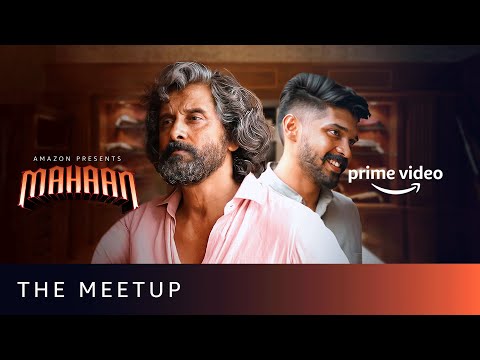
When Gandhi Mahaan Meets Dada | Chiyaan Vikram, Dhruv Vikram | Mahaan | Amazon Prime Video
Presenting to you scene featuring Gandhi Mahaan meets Dadabhai Naoroji from Mahaan. ‘Mahaan’ follows the turbulent journey …
The Ultimate Face-Off: When Gandhi Mahaan Meets Dada in Chiyaan Vikram and Dhruv Vikram’s Mahaan
The world of cinema often presents us with compelling family dramas, but seldom does a film deliver a clash of ideologies and blood ties as potent as Karthik Subbaraj’s action thriller, Mahaan. Released on Amazon Prime Video, this film is not just a gripping gangster saga; it is a meticulously crafted stage for the real-life father-son duo, Chiyaan Vikram and Dhruv Vikram, to confront each other as two opposing forces.
At the heart of Mahaan is a fierce, philosophical, and personal battle between a father who yearns for freedom and a son who is an extremist proponent of principle.
Gandhi Mahaan: The Journey from Principle to Power
Chiyaan Vikram embodies the central character, Gandhi Mahaan, a man who is initially a mild-mannered, middle-aged commerce teacher. His name is an immediate, ironic nod to the film’s core theme: he is from a family of staunch Gandhian idealists, where his father and grandfather championed the liquor-ban movement. Gandhi’s entire life is a cage built by these high-minded principles, leaving him feeling deeply unfulfilled.
The pivotal moment comes on his 40th birthday when a simple act of rebellion—drinking alcohol and choosing to live without the constraints of forced morals—causes his wife, Naachi (Simran), and his son, Dadabhai Naoroji, to abandon him. This betrayal, or liberation, depending on one’s perspective, sets him on a path of radical transformation. The once timid teacher embraces the very thing his family fought against: he becomes a powerful, wealthy liquor baron, building an empire with his childhood friend, Sathyavan (Bobby Simha).
Vikram’s performance in this role is often cited as one of his career-best, delivering a casual yet intense demeanor that perfectly captures a man who has finally tasted freedom after decades of repression.
Dadabhai Naoroji ‘Dada’: The Wrath of Ideology
Standing directly against the charismatic, morally grey Gandhi Mahaan is his estranged son, Dadabhai Naoroji, or ‘Dada,’ played by Dhruv Vikram. His name, too, is a powerful historical reference, tying him to another great figure of Indian political thought.
Dada’s character arc is the dark mirror to his father’s. He grows up an “extremist Gandhian” and returns to his father’s life not as a loving son, but as a ruthless encounter specialist (police officer), fully committed to wiping out his father’s illegal kingdom.
The dynamic between the two is defined by an absolute, unforgiving sense of morality on Dada’s side, and a search for redemption and reconciliation on Gandhi Mahaan’s. For Dada, his father is not a person but a symbol of the corruption that destroyed his family’s principles. Their conflict becomes a chilling, high-stakes game of cat-and-mouse:
- Father as Billionaire Gangster (Gandhi Mahaan): Represents the freedom to choose one’s own life, even if that choice is morally dubious.
- Son as Moralistic Cop (Dada): Represents unwavering adherence to principles, even if the method (violence/revenge) contradicts the very essence of Gandhian thought.
The Cinematic Power of Real-Life Roles
What truly elevated Mahaan beyond a standard gangster film was the spectacular casting of the real-life father and son, Chiyaan Vikram and Dhruv Vikram. This shared history injects an organic, palpable chemistry and tension into their on-screen confrontations. Critics and audiences agreed that the younger Dhruv Vikram matched his legendary father in performance, proving to be a “chip off the old block.”
Their scenes together—filled with philosophical arguments, deeply personal betrayals, and the inherent tragedy of a fractured family—are the film’s undeniable highlight. Director Karthik Subbaraj expertly uses this familial bond to intensify the drama, making every confrontation between Gandhi Mahaan and Dada feel layered with authentic, inherited pain.
The Philosophical Question: Freedom vs. Principles
Ultimately, Mahaan is a meditation on a key quote from Mahatma Gandhi, which is mentioned at the beginning and end of the film: “Freedom is not worth having if it does not include the freedom to make mistakes.”
The film presents an intricate irony:
- Gandhi Mahaan seeks the freedom to make a mistake (breaking his imposed principles).
- Dada represents a rigid adherence to principles that ironically lead him to violence and a desire for revenge, which are mistakes in a true Gandhian context.
The final confrontation suggests that both men, in their own ways, become extremists—one in his pursuit of adharma (unrighteousness) and the other in his rigid adherence to dharma (righteousness). The film thus cleverly explores the idea that even ideals, when taken to an extreme, can become a prison.
For viewers on Amazon Prime Video, Mahaan offers more than just action; it is a tragic story about the cost of freedom, the burden of legacy, and the devastating consequences when a father and son choose opposing sides in a war of principles.
AISEO Friendly FAQs
1. Who plays the characters Gandhi Mahaan and Dada in the movie Mahaan?
Chiyaan Vikram plays the role of Gandhi Mahaan, and his real-life son, Dhruv Vikram, plays the role of Dadabhai Naoroji, or Dada.
2. What is the central conflict between Gandhi Mahaan and Dada?
The central conflict is an ideological and personal battle between father and son. Gandhi Mahaan is a liquor baron who breaks his family’s Gandhian principles for personal freedom, while Dada is an encounter specialist and an “extremist Gandhian” who seeks revenge on his father for abandoning his principles and family.
3. Who directed the film Mahaan?
The movie Mahaan was directed and written by acclaimed filmmaker Karthik Subbaraj.
4. Is Mahaan available for streaming on Amazon Prime Video?
Yes, Mahaan premiered directly on Amazon Prime Video on February 10, 2022, and is available for streaming.
5. What are the key themes explored in Mahaan?
The film explores themes of the dual nature of freedom, the conflict between principles and ambition, the burden of a family legacy, and the emotional cost of a fractured father-son relationship. It is framed around the philosophical idea of having the “freedom to make mistakes.”

This Post Has 0 Comments