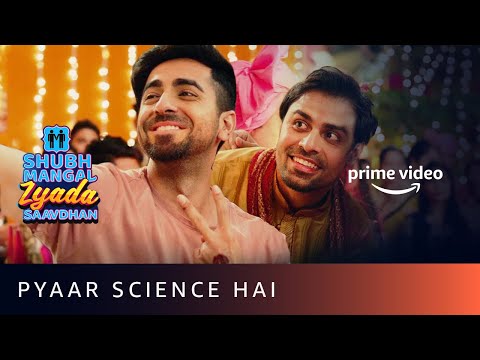
Pyaar Science Hai | Shubh Mangal Zyada Saavdhan | Ayushmann Khurrana, Jitendra Kumar, Gajraj Rao
When Jitendra Kumar talks about his emotions for Ayushmann Khurrana to his father, Gajraj Rao, he is not able to understand the …
Pyaar Science Hai: The Scientific Truth of Love in Shubh Mangal Zyada Saavdhan
In an era of Indian cinema where films are increasingly daring to tackle social taboos, Shubh Mangal Zyada Saavdhan stands out as a joyous and revolutionary piece of storytelling. Starring the dynamic trio of Ayushmann Khurrana, Jitendra Kumar, and Gajraj Rao, the film boldly centers on a same-sex love story, framed not as a tragedy or a struggle, but as a vibrant, laugh-out-loud family comedy.
At the heart of the film’s progressive message lies a single, powerful line of dialogue: “Pyaar Science Hai” (Love is Science). This phrase, delivered with a mix of defiance and simple truth, encapsulates the entire philosophy of the movie—that love, in any form, is a natural, unchangeable, and non-negotiable fact of human existence.
The Plot: Love Battles Tradition
Shubh Mangal Zyada Saavdhan (2020), written and directed by Hitesh Kewalya, is a spiritual sequel to the 2017 hit Shubh Mangal Saavdhan. While the first film tackled the topic of erectile dysfunction with a comedic touch, the sequel takes on the much larger societal issue of homosexuality and homophobia.
The story revolves around Kartik Singh (Ayushmann Khurrana) and Aman Tripathi (Jitendra Kumar), a happily committed gay couple. Trouble begins when they travel from Delhi back to Aman’s conservative, joint family in Allahabad for a cousin’s wedding. During the train journey, Aman’s traditional father, Shankar Tripathi (Gajraj Rao), discovers their relationship, which leads to a dramatic confrontation that derails the entire wedding celebration.
The rest of the film is a chaotic, heartwarming, and often hilarious battle as Kartik and Aman try to convince the Tripathi family, especially the deeply resistant Shankar, that their love is valid, real, and deserving of acceptance.
The Revolutionary Dialogue: “Pyaar Science Hai”
The defining moment that delivers the film’s core argument is the confrontation between Aman (Jitendra Kumar) and his father, Shankar (Gajraj Rao). The family, in a misguided attempt to “fix” their son, suggests seeking medical help, echoing a common societal misconception that homosexuality is a curable disease.
Aman’s mother, Sunaina (Neena Gupta), suggests, “Beta, hum tere acche doctor se ilaaj karwaenge. Medical Science ne bahut tarakki kar li hai, tu theek ho jaaega beta” (Son, we will get you treated by a good doctor. Medical Science has progressed a lot, you will get well, son).
It is here that Aman pushes back with the film’s thesis:
“Aapka Oxytocin wala pyaar, aur mera Oxytocin wala bimaari?” (Your love based on Oxytocin, and my disease based on Oxytocin?)
He argues that if there is a biological, scientific reason for everything else, then love—the deep, human connection he feels for Kartik—is also rooted in science, biology, and the natural order of things. By framing love as a “vighyan” (science), the film strips away the moral and religious dogma often used to condemn same-sex relationships, presenting it instead as a simple, biological, and undeniable fact.
- The Scientific Approach: The phrase reframes the conversation, challenging the family’s view that Aman’s orientation is a choice or a flaw. It suggests that love is an intrinsic chemical and emotional bond, a natural expression that cannot be controlled or changed by a ‘cure.’
- Normalization: By equating gay love with “science,” the film instantly normalizes it, placing it in the realm of the objective and factual, rather than the subjective and controversial. It is not an ‘issue’ but a simple truth.
The Power-Packed Cast
The film’s success is heavily reliant on its brilliant casting, bringing together actors celebrated for their ability to balance comedy with deep emotionality.
Ayushmann Khurrana as Kartik Singh
Ayushmann Khurrana, known for his track record of championing films on social issues, plays Kartik, the more expressive and rebellious of the couple. Kartik is the catalyst who refuses to hide their relationship, forcing the Tripathi family to confront their prejudice. Khurrana’s performance infuses the character with confidence and charm, making him a compelling and unapologetic champion of the “Love Is Love” message.
Jitendra Kumar as Aman Tripathi
Jitendra Kumar, in his debut film role, is the vulnerable and relatable Aman. Aman is caught between the man he loves and the traditional family he cherishes. Kumar portrays the internal conflict and eventual emergence of courage, which allows the audience to deeply connect with the emotional cost of hiding one’s true self.
Gajraj Rao as Shankar Tripathi
Gajraj Rao delivers a superb performance as Shankar Tripathi, the patriarch who epitomizes the small-town, traditional Indian father. His shock, denial, and hilarious attempts to ‘fix’ his son provide much of the film’s central conflict and comedy. Rao’s transformation from homophobic father to a grudging acceptor represents the generational shift the film advocates for.
A Giant Leap for Bollywood
Shubh Mangal Zyada Saavdhan is more than just a comedy; it is a significant step for LGBTQ+ representation in mainstream Indian cinema. By using the universally accepted format of a big, fat Indian wedding and the chaos of a joint family, the film successfully served a radical social message on a familiar, accessible platter. The film’s core message—that pyaar is science—is a call to treat love and sexuality with the respect of a natural phenomenon, urging society to embrace a scientific, and therefore, humane perspective on acceptance.
AISEO-Friendly FAQs
Q: What is the central theme of Shubh Mangal Zyada Saavdhan?
A: The central theme is the love story of a gay couple, Kartik and Aman, and their struggle to gain acceptance from Aman’s conservative, traditional family, thereby promoting LGBTQ+ representation and challenging homophobia in Indian society.
Q: Who are the main actors in Shubh Mangal Zyada Saavdhan?
A: The main actors are Ayushmann Khurrana (as Kartik Singh), Jitendra Kumar (as Aman Tripathi), and Gajraj Rao (as Aman’s father, Shankar Tripathi). Neena Gupta also plays Aman’s mother, Sunaina Tripathi.
Q: What does the dialogue “Pyaar Science Hai” mean in the context of the movie?
A: “Pyaar Science Hai” (Love is Science) is a powerful statement made by Aman (Jitendra Kumar) to his parents. It means that love and one’s sexual orientation are not a choice, a fault, or a disease, but a natural, biological, and non-negotiable part of human nature, much like a scientific fact, which challenges the idea of seeking a ‘cure’ for homosexuality.
Q: Is Shubh Mangal Zyada Saavdhan a sequel?
A: Yes, it is considered a “spiritual successor” to the 2017 film Shubh Mangal Saavdhan, as it deals with another taboo social issue (homosexuality) using the same genre of a romantic comedy, though the plots are unrelated.
‘Pyaar Science Hai’: How Shubh Mangal Zyada Saavdhan Used Chemistry to Prove Love
The landscape of mainstream Hindi cinema saw a significant, vibrant shift in 2020 with the release of Shubh Mangal Zyada Saavdhan (SMZS). More than just a romantic comedy, the film was a bold, unapologetic, and humorous confrontation of homophobia, packaged neatly within a traditional, small-town family drama. At the heart of this confrontation lay a simple yet profound dialogue that became the film’s core argument: “Pyaar Science Hai” (Love is Science).
Starring Ayushmann Khurrana, Jitendra Kumar, and Gajraj Rao, the movie’s brilliance was in its decision to treat same-sex love not as a foreign concept or an intellectual issue, but as a basic, universal biological fact that even a conservative, middle-class family could understand—or, at least, be forced to confront.
The Scientific Argument for Love
The now-iconic phrase, “Pyaar Science Hai,” is delivered by the character Kartik Singh, played with electric conviction by Ayushmann Khurrana. Kartik is the more outgoing half of the couple, who is determined to make Aman’s (Jitendra Kumar) conservative family accept their relationship. The dialogue is aimed squarely at Aman’s father, Shankar Tripathi (Gajraj Rao), a conservative agricultural scientist.
By framing love as a matter of “science” or “vigyan,” the film subtly shifts the conversation from morality and tradition to logic and biology. In a pivotal scene, Kartik explains his feelings for Aman using the very language that Shankar Tripathi, the patriarch and a scientist by profession, values most. He doesn’t just profess love; he breaks down the neurochemistry of affection.
The Chemistry of Affection
The film’s argument cleverly dissects the universal human experience of falling in love into its component chemical parts, irrespective of gender:
- Dopamine: This is the “feel-good” neurotransmitter responsible for pleasure and reward, which floods the body during the excitement of a new romance.
- Oxytocin: Often called the “cuddle hormone” or the “love drug,” oxytocin is associated with bonding, trust, and relationship building.
- Cortisol: While primarily a stress hormone, the film hints at the intense, almost overwhelming physical reaction that even a simple touch or kiss can trigger.
Kartik’s simple yet powerful thesis is that the biological and chemical reactions of love—the quickened pulse, the burst of happiness, and the profound feeling of connection—are identical whether a man loves a woman or a man loves a man. By reducing love to a chemical equation, the film makes the homophobic argument about ‘unnatural’ love logically unsound.
The Three Pillars: Ayushmann, Jitendra, and Gajraj
The film’s success in delivering this sensitive yet complex narrative is intrinsically tied to the performance of its lead trio.
Ayushmann Khurrana as Kartik Singh
Ayushmann Khurrana, known for selecting films that address social taboos, anchors the film as the spirited and assertive Kartik. Kartik is the disruptor who refuses to hide, challenging the family’s deep-seated prejudices with a mix of charm, aggression, and relentless optimism. His energy provides the necessary comedic momentum, preventing the heavy subject matter from becoming too preachy.
Jitendra Kumar as Aman Tripathi
Jitendra Kumar’s portrayal of Aman Tripathi is the film’s emotional core. Aman is the ladla beta (darling son) trapped between his love for Kartik and his fear of confronting his conservative, small-town family. His performance conveys the quiet desperation and internal conflict of an individual struggling for acceptance from the very people he cherishes.
Gajraj Rao as Shankar Tripathi
Gajraj Rao, reuniting with Neena Gupta in a dynamic reminiscent of Badhaai Ho, plays the formidable patriarch Shankar Tripathi. As an agricultural scientist focused on his experimental black cauliflower, his own life is a study in unconventionality, which is cleverly used to expose the hypocrisy of his traditional beliefs. Rao’s nuanced performance captures the evolution of a man struggling to reconcile his love for his son with decades of ingrained prejudice. His initial attempts to “cure” his son’s “condition” are met with Kartik’s scientific rebuttal, forcing him to engage with the reality of love beyond his narrow definition.
A Necessary Nudge for Mainstream Bollywood
Shubh Mangal Zyada Saavdhan was a landmark film for Indian cinema, bringing a queer romance narrative firmly into the commercial mainstream space. By setting the story within a typical North Indian wedding, complete with family quarrels and melodrama, the film normalises the LGBTQIA+ experience, suggesting that a same-sex couple’s struggle for acceptance is just another version of a classic family drama. The dialogue “Pyaar Science Hai” encapsulates this powerful, normalising strategy, proving that love—in any form—is nothing more, and nothing less, than a natural, chemical reaction, a truth that no amount of social conservatism can deny.
AISEO Friendly FAQs
1. What is the main theme of the movie Shubh Mangal Zyada Saavdhan?
The main theme of Shubh Mangal Zyada Saavdhan is same-sex love and the struggle of a gay couple, Kartik and Aman, to gain acceptance for their relationship from Aman’s conservative, orthodox, middle-class Indian family.
2. Who plays the main characters in Shubh Mangal Zyada Saavdhan?
Ayushmann Khurrana plays Kartik Singh, and Jitendra Kumar plays Aman Tripathi, the gay couple. Gajraj Rao plays Aman’s conservative father, Shankar Tripathi, and Neena Gupta plays his mother, Sunaina Tripathi.
3. What does “Pyaar Science Hai” mean in the context of the film?
“Pyaar Science Hai” (Love is Science) is a core dialogue from the film where the character Kartik argues that love, including same-sex love, is a natural, biological process involving neurochemicals like dopamine and oxytocin. He uses this scientific reasoning to challenge the family’s belief that homosexuality is a choice, a mental illness, or “unnatural.”
4. Is Shubh Mangal Zyada Saavdhan a sequel to Shubh Mangal Saavdhan?
Shubh Mangal Zyada Saavdhan is a “spiritual successor” to the 2017 film Shubh Mangal Saavdhan. Both films address social taboos (the first dealt with erectile dysfunction, and the second with homosexuality) with a humorous, family-friendly approach, but they have distinct plots and characters.
5. Was Shubh Mangal Zyada Saavdhan a commercial success?
Yes, Shubh Mangal Zyada Saavdhan was a commercial success after its worldwide release on February 21, 2020.

This Post Has 0 Comments