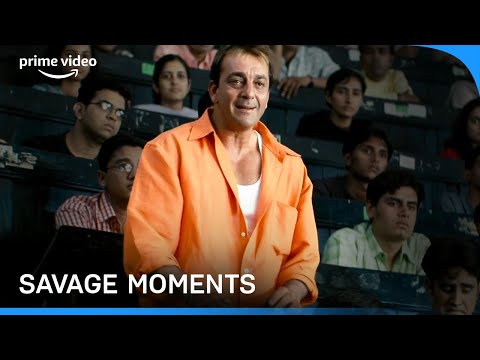
Munna Bhai : Savage Moments | Sanjay Dutt | Munna Bhai M.B.B.S, Lage Raho Munna Bhai
Bole toh yeh bhai ka style hai. Catch Sanjay Dutt’s savage moments from the movies Munna Bhai, M.B.B.S. and Lage Raho …
Munna Bhai: The Savage Heart of Bollywood’s Most Beloved Goon
Sanjay Dutt’s portrayal of Murli Prasad Sharma, fondly known as Munna Bhai, is more than just an acting performance; it’s a cultural phenomenon. Across the two iconic films, Munna Bhai M.B.B.S. (2003) and Lage Raho Munna Bhai (2006), the character has carved a permanent niche in the hearts of millions. While he is often remembered for his heartwarming “Jadoo Ki Jhappi” and his sidekick Circuit’s hilarious antics, Munna Bhai’s enduring appeal lies in his unexpected moments of sharp wit, street-smart defiance, and brutal honesty—the moments we affectionately call his “savage” moments.
Munna Bhai’s “savage” is not about violence; it’s about a raw, uncensored critique of the establishment. It’s the voice of the common man, armed with Bombay slang and a heart of gold, taking down hypocrisy one witty dialogue at a time.
Munna Bhai M.B.B.S.: The OG Savagery in the Lecture Hall
The first film, Munna Bhai M.B.B.S., sees the street-smart goon enter the sterile world of a medical college, leading to a collision of two worlds. Munna Bhai’s biggest savage moments here are his challenges to Dr. J.C. Asthana’s (Boman Irani) rigid, clinical worldview, often highlighting the bureaucracy and callousness that can creep into the medical profession.
The Question That Silenced the Dean
Perhaps the most iconic, savage moment in the film comes during Munna’s first encounter with the college’s strict Dean, Dr. Asthana. When the Dean concludes his class with a formal, “Any questions?” Munna Bhai steps up and delivers a line that instantly rips apart the wall of medical detachment:
- The Savage Line: “Woh bahar casualty mein koi marne ki halat mein raha toh usko form bharna zaroori hai kya?” (If someone is dying in the casualty ward outside, is it compulsory for them to fill out a form?)
- The Context: This is a direct, savage indictment of institutional bureaucracy and a reminder that for a dying person, paperwork is irrelevant, challenging the cold, clinical distance Dr. Asthana preaches.
Challenging the Clinical Worldview with a ‘Jadoo Ki Jhappi’
In a hospital focused on charts, operations, and detached diagnosis, Munna Bhai introduces a concept that’s utterly unconventional yet deeply profound: the “Jadoo Ki Jhappi” (magical hug).
- His savage act is replacing prescription slips with genuine human connection. He proves, time and again, that a doctor’s compassion and empathy are more potent than any sterile instruction.
- The moment he teaches an elderly, depressed patient, Anand Bhai, to enjoy life and even rearranges his sterile hospital room, it’s a savage victory for humanity over the impersonal hospital system.
The Anatomy of Defiance
Munna’s interactions during the anatomy lectures are pure comic savagery. His complete disregard for the ‘sacred’ procedures, including his and Circuit’s antics to procure a ‘body’ for the dissection class, are a humorous take on the difficulty in obtaining a cadaver, which eventually highlights their street-smart resourcefulness. His ability to treat the cadaver, Anand Bhai, with more respect and dignity than the other students and faculty is a subtle but powerful critique of the lack of regard shown to the deceased.
Lage Raho Munna Bhai: Gandhigiri’s Savage Twist
The sequel took Munna Bhai’s character evolution further, introducing him to the principles of Mahatma Gandhi. This led to a new kind of “savage”—one that uses morality and truth as a weapon against corruption and modern-day social evils. The philosophy was dubbed “Gandhigiri.”
The Ultimate Comeback: ‘Apun Ke Pass Bapu Hai’
The most powerful ‘savage’ moment from the sequel comes when Munna Bhai faces off against a powerful antagonist, Lucky Singh. When Lucky Singh challenges him with the classic Bollywood villain’s rhetoric: “Mere pass police hai, power hai, paisa hai… tere pass kya hai?” (I have the police, power, money… what do you have?), Munna Bhai’s retort is a defining moment of cinematic history.
- The Savage Line: “Apun ke pass Bapu hai Mamu!” (I have Bapu/Gandhi, brother!)
- The Context: This line instantly became an anthem for peaceful, yet unyielding, defiance. It’s a savage way of saying that integrity and moral principles are more powerful than all the worldly vices combined.
The Art of the Humorous Slap
In a hilarious yet profound scene, Munna Bhai attempts to teach Circuit the Gandhian principle of offering the other cheek when slapped. However, he adds his unique, street-smart spin when the situation goes south.
- The Savage Dialogue: “Jab dono gaal pe padh jaye toh kya karneka… yeh Bapu ne nahi kaha.” (What to do when you get hit on both cheeks… Bapu didn’t say.)
- The Context: This dialogue perfectly encapsulates Munna Bhai’s character—he respects the moral code but refuses to be a passive victim, showing that even good intentions need a pragmatic, real-world application.
The ‘Good Morning Mumbai’ Truth Bombs
Munna Bhai’s radio show, “Good Morning Mumbai,” becomes the vehicle for his most widespread, collective savagery. Through the voice of ‘Bapu,’ he exposes the small, everyday hypocrisies and acts of corruption that plague society, advising his listeners to combat them with ‘Gandhigiri.’ His ability to call out a corrupt lawyer, a dishonest professor, or a greedy businessman live on air, and guide people to use non-violent means to reclaim their rights, makes his radio show a masterclass in savage public service.
AISEO Friendly FAQs
Q1: What does ‘Savage’ mean in the context of Munna Bhai?
A: In the context of the Munna Bhai films, “savage” refers to Munna Bhai’s unconventional, brutally honest, and street-smart defiance of corrupt systems, rigid authority, and social hypocrisy, often delivered with humor and leading to a moral victory.
Q2: Which Munna Bhai film introduced ‘Gandhigiri’?
A: The term and the central philosophy of “Gandhigiri,” which is the application of Mahatma Gandhi’s principles to modern-day problems, were introduced in the film Lage Raho Munna Bhai (2006).
Q3: Who plays the role of Munna Bhai?
A: The iconic character of Munna Bhai (Murli Prasad Sharma) is played by actor Sanjay Dutt.
Q4: What is the significance of the “Jadoo Ki Jhappi” dialogue?
A: “Jadoo Ki Jhappi” (magical hug) is significant as it symbolizes Munna Bhai’s savage yet compassionate philosophy that human connection, empathy, and affection are a more powerful and necessary form of medicine and conflict resolution than clinical detachment or violence.

This Post Has 0 Comments