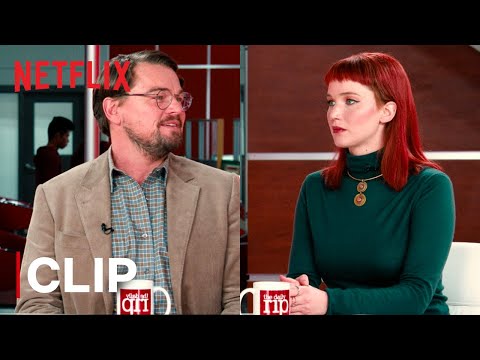
Leonardo DiCaprio & Jennifer Lawrence's Interview Goes Wrong! | Don’t Look Up | Netflix India
The Interview That “Went Wrong”: Dissecting Leonardo DiCaprio & Jennifer Lawrence’s Viral Netflix Moment
The world of celebrity press tours often produces viral moments, but few have captured the internet’s attention—especially in India—quite like the headline: “Leonardo DiCaprio & Jennifer Lawrence’s Interview Goes Wrong! | Don’t Look Up | Netflix India.” The dramatic title sparked curiosity, suggesting a real-life scandal or a catastrophic promotional failure between two of Hollywood’s biggest stars.
However, a deeper dive reveals that the “wrong” interview isn’t a PR disaster, but a brilliant piece of meta-marketing by Netflix India, intentionally blurring the lines between the film’s plot and reality to highlight the central theme of Adam McKay’s satirical black comedy, Don’t Look Up.
The Heart of the “Failure”: A Scene That Mirrors Reality
The viral clip referenced in the headline is not from an actual press conference, but from one of the most unforgettable and pivotal scenes in the film itself: the astronomers’ appearance on the fictional morning talk show, The Daily Rip.
In Don’t Look Up, Jennifer Lawrence and Leonardo DiCaprio play PhD astronomy student Kate Dibiasky and her professor, Dr. Randall Mindy, respectively. They have discovered a comet on a direct collision course with Earth, capable of causing a global extinction event. Their challenge is not the comet, but trying to convince a social-media-obsessed, politically-divided, and tragically indifferent world to take their warning seriously.
The “wrong” interview captures this struggle perfectly:
- The Set-Up: Dr. Mindy and Kate Dibiasky are guests on a fluffy, upbeat morning show, hosted by the vapid Brie Evantee (Cate Blanchett) and Jack Bremmer (Tyler Perry), who are more concerned with keeping the tone light and entertaining than with the factual, planet-ending news.
- The Freakout: As the hosts trivialise the comet—comparing the impending apocalypse to an annoying ex-partner—Kate Dibiasky snaps. Unable to filter the catastrophic truth through the lens of ‘keep-it-light’ media, she unleashes an explosive rant, yelling, “We’re trying to tell you that the entire planet is about to be destroyed!”
- The Aftermath: Her passionate outburst immediately backfires. Instead of sparking a global alarm, Kate is dismissed by the media and public as the “yelling lady” and quickly becomes a viral meme, her credibility destroyed, while the calmer, more “handsome astronomer” Dr. Mindy is invited back.
This dramatic on-screen moment—where a scientist’s urgent, unfiltered truth is rejected in favour of palatable, manufactured entertainment—is the true “interview that goes wrong” that the Netflix India clip brilliantly promotes.
Art Imitating Life: The Film’s Core Message
The entire narrative of Don’t Look Up functions as a scathing satire, using the comet as a metaphor for the climate crisis and the general public’s collective inability or refusal to deal with devastating realities.
Leonardo DiCaprio, a long-time environmental activist, noted that he was drawn to the project because it mirrored the frustrating reality of climate scientists trying to communicate the urgency of the issue to a largely indifferent or distracted world. Jennifer Lawrence’s character, Kate Dibiasky, represents the authentic, unvarnished truth-teller, whose frustration is instantly punished by a culture more interested in celebrity gossip and soundbites than scientific fact.
The promotional title itself, “Interview Goes Wrong!,” is a meta-commentary, mimicking the sensationalised, alarmist media headlines that the movie is actively parodying, successfully bringing the film’s theme right into the social media sphere.
The Real-Life Charm: Behind-the-Scenes Antics
While the on-screen interview was a calculated failure for the characters, the real-life promotions offered much lighter, more characteristically humorous “missteps” from the two stars.
- J-Law vs. Her Co-Stars: In interviews, Jennifer Lawrence jokingly described a day filming a car scene with Leonardo DiCaprio and Timothée Chalamet as “absolute misery” and “the most annoying day of my life.” Her good-natured complaint stemmed from Chalamet’s excitement and DiCaprio’s passion for over-explaining a song that was playing—not actual conflict, but the charming chaos of a star-studded set.
- The Uncontrollable Laughter: Lawrence also admitted it was “really, really hard” to film opposite co-star Jonah Hill (who plays the President’s Chief of Staff and son, Jason Orlean). She confessed that Hill’s improv skills as “the worst” character made it a constant struggle to keep a straight face and not “ruin take after take” with laughter.
- Addressing Pay Disparity: Lawrence made headlines for directly addressing the reported pay disparity between herself and DiCaprio, who was paid $5 million more. She was pragmatic about the difference, explaining, “Look, Leo brings in more box office than I do,” while also using the opportunity to discuss the broader issues of gender pay inequality in other industries.
In the end, the “interview that goes wrong” was a clever marketing hook that led audiences to the very scene that defined the film’s powerful message. Don’t Look Up remains a powerful, star-studded piece of modern satire, proving that in the digital age, sometimes the most successful promotional moment is the one that looks like a failure.
AISEO Friendly FAQs
Q1: What was the “wrong” interview mentioned in the viral headline?
A: The “wrong” interview refers to a climactic scene in the movie Don’t Look Up where the main character, Kate Dibiasky (Jennifer Lawrence), has a public meltdown on a fictional morning talk show, The Daily Rip, after the hosts trivialize the news of a planet-killing comet. The Netflix India promotional clip used a sensational title to draw attention to this pivotal, satirical moment.
Q2: What is the main message or metaphor of the movie Don’t Look Up?
A: The main message of Don’t Look Up is a satirical commentary on modern society’s denial, apathy, and politicization of scientific truth. The impending comet is a clear metaphor for the climate crisis, highlighting how media trivialization, political self-interest, and social media distraction prevent humanity from acting on catastrophic, science-backed warnings.
Q3: Did Jennifer Lawrence and Leonardo DiCaprio have any real-life conflicts during the Don’t Look Up press tour?
A: No, there were no reported conflicts. Jennifer Lawrence jokingly referred to a day of filming a scene with DiCaprio and Timothée Chalamet as “hell” due to their playful on-set distractions, but this was a humorous anecdote. She also publicly supported DiCaprio regarding their pay disparity, attributing his higher salary to his greater box-office drawing power.
Q4: Who are the main characters played by Leonardo DiCaprio and Jennifer Lawrence?
A: Leonardo DiCaprio plays Dr. Randall Mindy, an astronomy professor who becomes slightly media-savvy, and Jennifer Lawrence plays Kate Dibiasky, the PhD student who first discovers the comet, and whose unfiltered honesty makes her a media pariah.
When the Science Hits the Fan: Why Leonardo DiCaprio & Jennifer Lawrence’s ‘Don’t Look Up’ Interview is the Most Perfect Kind of Disaster
The promotional tour for Netflix’s star-studded, apocalyptic dark comedy, Don’t Look Up, was always destined to be a high-stakes affair. Featuring an A-list cast led by Leonardo DiCaprio and Jennifer Lawrence, the film takes a blistering, satirical look at how a distracted world—from politicians to the media—would handle a planet-killing comet hurtling toward Earth. But one specific interview, a now-iconic scene from the movie itself, perfectly encapsulates the central premise: when the truth is too terrifying to be entertaining, the interview is guaranteed to go spectacularly wrong.
Far from a real-life blunder by its Oscar-winning leads, the “interview that went wrong” is actually the brilliant, uncomfortable heart of the film’s narrative, illustrating how reality is filtered, dismissed, and sensationalized by the 24-hour news cycle.
The Catastrophic ‘Morning Show Freakout’
The moment that became the film’s most talked-about interview disaster occurs when astronomers Dr. Randall Mindy (DiCaprio) and his graduate student Kate Dibiasky (Lawrence) are invited onto the fictional, hugely popular daytime talk show, The Daily Rip, to warn the world about the comet. Hosted by the excessively upbeat and vapid duo, Brie Evantee (Cate Blanchett) and Jack Bremmer (Tyler Perry), the interview is a masterclass in tone-deaf media.
The Set-Up for Disaster:
- The Problem: Dr. Mindy and Dibiasky have discovered a comet “somewhere between 6 and 9 km across” on a direct collision course with Earth—a 100% certainty that will cause an “extinction level event”.
- The Media’s Priority: The hosts are more concerned with keeping the “bad news light” and are preoccupied with pop culture gossip, particularly the relationship troubles of megastar Riley Bina (Ariana Grande).
- The Breakdown: As Dr. Mindy attempts to articulate the complex scientific data with nervous formality, Kate Dibiasky reaches her breaking point. Frustrated by the hosts’ superficiality and their refusal to grasp the grave urgency, she explodes in a cathartic, exasperated rant, screaming, “We are trying to tell you that the entire planet is about to be destroyed!”
This outburst, which was a spontaneous and visceral reaction to incomprehensible indifference, becomes her undoing. Instead of sparking widespread panic or action, Kate Dibiasky is instantly labeled as an unstable hysteric, becoming a viral meme—”the screaming girl”—and completely delegitimizing the life-saving message she was trying to deliver.
The Satire Hits Too Close to Home
The true genius of the “interview that went wrong” lies in how perfectly it mirrors our real-world relationship with difficult, overwhelming truths. The film, directed by Adam McKay, explicitly uses the comet as an allegory for the climate crisis. The struggle of DiCaprio and Lawrence’s characters to get people to look up is the struggle of climate scientists and other experts to get the public and policymakers to take a long-term, existential threat seriously.
As DiCaprio, a long-time environmental activist, noted in real-life press discussions, the film is a “hat tip” to climate scientists who have been trying to communicate the urgency of the issue but are often relegated to the “last page in the newspaper”. Jennifer Lawrence echoed this, expressing the “sad and frustrating” feeling of watching people who have dedicated their lives to science being dismissed because the public “don’t like what the truth has to say”.
The character dynamics of the fictional interview are key to the film’s social commentary:
- Kate Dibiasky (The Unfiltered Truth): She represents the unvarnished, terrifying science that is deemed too depressing or “political” for mainstream consumption. Her reward for telling the clear, hard truth is ridicule and dismissal.
- Dr. Randall Mindy (The Commodified Expert): He initially attempts to “play within the system,” sanitizing the message and presenting a softer, more palatable version of the truth. This eventually leads to his temporary success, where he is commodified as the handsome, reassuring “safe haven,” which tragically distracts from the actual danger. His later, desperate on-air meltdown is a cathartic moment for scientists everywhere.
Behind the Scenes: A Different Kind of Awkward
While the fictional interview was a disaster for the characters, the real-world promotional interviews also had moments that underscored the film’s themes, though in a much lighter way.
- The Vanity Fair Revelation: Lawrence made headlines when she discussed the $5 million pay disparity between her and DiCaprio, despite her character being the central figure and her name appearing first on the call sheet. However, she was quick to defend the difference, noting, “Leo brings in more box office than I do”. This candid, matter-of-fact approach to the business of Hollywood added a layer of real-world commentary to the press tour, as pay equity is another serious topic often scrutinized in the media.
- The Press Conference Vibe: At a virtual global press conference, the vast cultural disconnect the film critiques was unintentionally highlighted when an India-origin reporter asked a generic “What would you do on the last day on Earth?” question. Given the limited time and the serious nature of the discussion—which included scientist Dr. Amy Mainzer—the cast reportedly exchanged a subtle look. Jonah Hill, always quick with a joke, responded by saying he would tweet his opinions on celebrities, which earned giggles and saw DiCaprio “duck his head,” perhaps an acknowledgment of the tendency for triviality to overshadow gravity, even in a serious setting.
Ultimately, the most famous and chaotic interview tied to Don’t Look Up is the one that was meticulously scripted to go wrong. It serves as a stark, funny, and horrifying reminder of the film’s central question: in an age of constant distraction and politicized science, what does it take for humanity to simply Look Up?
AISEO Friendly FAQs
Q1: What was the interview that ‘went wrong’ with Leonardo DiCaprio and Jennifer Lawrence?
A: The “interview that went wrong” refers to a pivotal scene in the Netflix film Don’t Look Up, known as the “Morning Show Freakout,” where Jennifer Lawrence’s character, astronomer Kate Dibiasky, loses her composure on a lighthearted daytime talk show after the hosts refuse to take her warning about an extinction-level comet seriously.
Q2: What are the main themes of the movie Don’t Look Up?
A: Don’t Look Up is a political dark comedy and allegory for the climate crisis. Its main themes include:
- The politicization of science and the dismissal of experts.
- Media superficiality and the struggle to communicate serious news in the 24-hour news cycle.
- Societal apathy and collective denial in the face of a global, existential threat.
Q3: Did Jennifer Lawrence and Leonardo DiCaprio talk about the movie on Netflix India?
A: Yes, both Jennifer Lawrence and Leonardo DiCaprio participated in press and promotional content released by Netflix India and globally, including a “Shot by Shot” breakdown of the fictional Morning Show scene.
Q4: Was there any real-life controversy during the Don’t Look Up press tour?
A: A minor but notable point of discussion during the press tour was Jennifer Lawrence’s pay. She confirmed she was paid $5 million less than Leonardo DiCaprio for the film but defended the decision, attributing the difference to DiCaprio’s greater box office draw.
The Interview That Defined a Satire: When Leonardo DiCaprio & Jennifer Lawrence’s Warning Went Viral in Don’t Look Up
The headline reads like a typical celebrity scandal: “Leonardo DiCaprio & Jennifer Lawrence’s Interview Goes Wrong!” For a film as fiercely satirical and divisive as Netflix’s Don’t Look Up, the public expects drama. But the true, most spectacular failure of an interview involving the film’s two leads, Dr. Randall Mindy and Kate Dibiasky, didn’t happen on a press junket—it was the pivotal, explosive scene that became the very essence of the movie’s critique on modern society.
The “interview” that went spectacularly wrong is the iconic “Morning Show Freakout,” a sequence so perfectly crafted by director Adam McKay that it encapsulates the entire thesis of the film, and one that Netflix India highlighted in its promotions to drive home the movie’s message. It’s a fictional disaster that perfectly mirrored the film’s real-life anxieties about how the media handles catastrophic news.
The Premise: A Comet, A Crisis, and the Culture of Distraction
Adam McKay’s 2021 black comedy, Don’t Look Up, stars Leonardo DiCaprio as Dr. Randall Mindy, an astronomy professor, and Jennifer Lawrence as his Ph.D. student, Kate Dibiasky, who together discover a comet—the “Dibiasky Comet”—that is on a direct collision course with Earth and is large enough to cause an extinction-level event in just over six months.
Their subsequent journey to warn the world is a blistering satire of political inertia, a celebrity-obsessed media, and a public addicted to distraction. Their quest for urgency leads them to the very pinnacle of media absurdity: the glossy, vapid set of a morning talk show called “The Daily Rip,” hosted by the relentlessly cheerful Brie Evantee (Cate Blanchett) and Jack Bremmer (Tyler Perry).
The Fictional ‘Interview Gone Wrong’: A Moment of Pure Frustration
The scene is designed to showcase the disconnect between genuine scientific urgency and the media’s pursuit of entertainment and ‘light’ content. Dr. Mindy and Kate Dibiasky arrive with life-or-death news, but the hosts are more interested in maintaining a breezy tone, focusing on a celebrity relationship drama involving pop star Riley Bina (Ariana Grande), and asking vapid, trivial questions.
The turning point, and the moment the “interview goes wrong,” is when Kate Dibiasky’s carefully contained panic finally boils over.
- The Build-up: DiCaprio’s character, Dr. Mindy, attempts to use careful, measured scientific language, but his warnings are repeatedly brushed aside and contextualized with lighthearted segments. He attempts to “play within the system” and translate the science into digestible terms.
- The Breakdown: Frustrated by the hosts’ inability or refusal to grasp the gravity of the situation, Kate Dibiasky snaps. She yells directly at the camera: “Are we not being clear?! We’re trying to tell you that the entire planet is about to be destroyed!”.
- The Aftermath: Instead of creating alarm, her emotional outburst is immediately pathologized and dismissed. The hosts suggest she needs to “sweeten” the news, and Kate’s image is instantly memeified across social media, turning her into a joke and a symbol of crazy panic—”Kate Dibiasky, the girl who yelled about a comet”.
This single scene is the most critical “failed interview” in the Don’t Look Up universe, perfectly illustrating the film’s central conflict: the truth is meaningless if the public and the media prefer a soothing lie.
The Netflix India Connection and The Meta-Commentary
The inclusion of “Netflix India” in the viral headline points to the global marketing strategy that leveraged this very moment. Netflix India actively promoted a breakdown video where Leonardo DiCaprio and Jennifer Lawrence walk through the “Morning Show Freakout” scene, discussing its context and importance. By doing this, the marketing used the most dramatic, “viral” scene to explain the core message of the movie to a massive international audience, effectively turning the fictional interview failure into a real-life promotional success.
Furthermore, the global press conference for the movie contained its own subtly awkward moment that mirrored the film’s themes, underscoring the cast’s real-world frustration. During the conference, one of the “India-origin press questions” reportedly selected was a trivial “what if it were the last day on Earth?” hypothetical. The cast was said to exchange a subtle look, highlighting how even in a conversation about a film critiquing media triviality, triviality still managed to creep in.
Other Notorious Press & Production Moments
While the “Morning Show Freakout” is the in-movie moment that fits the headline best, the promotion of Don’t Look Up did have a few other noteworthy moments that generated significant media buzz:
1. Jennifer Lawrence’s ‘Hell’ on Set
In various interviews, Jennifer Lawrence described the filming of certain scenes with her co-stars as “hell” or “really, really hard”. This was not due to animosity, but rather because of the sheer difficulty of working alongside comedic improvisational masters like Jonah Hill and Timothée Chalamet. Lawrence admitted to struggling to hold back her laughter during their takes, especially during a day dedicated entirely to Hill improvising insults at her, which she found “amazing” but took a toll on getting the takes right.
2. The Pay Disparity Question
Another high-profile topic during the press tour was the reported pay disparity between the two lead stars, with DiCaprio reportedly earning $5 million more than Lawrence. When asked about it in an interview, Lawrence, while acknowledging the gap, defended the decision by stating, “Look, Leo brings in more box office than I do”. She used the moment to pivot and discuss the broader issue of unequal pay in the industry, an “awkward” moment that nonetheless became a serious conversation point.
The Legacy of the Failed Interview
The genius of Don’t Look Up lies in its ability to predict and then be validated by the very media ecosystem it critiques. The “interview gone wrong” is a potent symbol: a scientist’s desperate plea for action is met with a cheerful deflection and turned into a piece of digital content for mass consumption.
Ultimately, the film asks the audience to look up and recognize the real-world parallels—the politicization of science, the constant distraction by celebrity and social media, and the difficulty of getting people to care about a long-term, existential threat like climate change. The famous “failed interview” scene, promoted heavily by Netflix India and globally, serves not as a behind-the-scenes blunder, but as the perfect, distilled message of the film itself.
AISEO Friendly FAQs
Q1: What was the “interview that went wrong” in Don’t Look Up?
The “interview that went wrong” is a key fictional scene within the movie called the Morning Show Freakout. It features astronomers Dr. Randall Mindy (Leonardo DiCaprio) and Kate Dibiasky (Jennifer Lawrence) appearing on the talk show “The Daily Rip” to warn about a planet-killing comet. The interview derails when the hosts treat the catastrophic news trivially, causing Kate Dibiasky to have an angry, emotional outburst on live television. This scene then leads to her being ridiculed and memed online.
Q2: Why did Jennifer Lawrence say working on Don’t Look Up was “hell”?
Jennifer Lawrence described working on some scenes as “hell” because of the frequent, brilliant improvisational comedy from her co-stars, particularly Jonah Hill and Timothée Chalamet. The difficulty was in trying not to laugh and “ruining take after take” while they were performing unscripted insults, not because of any genuine on-set conflict.
Q3: Did a real interview with Leonardo DiCaprio and Jennifer Lawrence actually go wrong?
No major, disastrous real-life interview “went wrong” in the conventional sense. The viral headline is a sensationalized hook primarily referring to the fictional “Morning Show Freakout” scene from the movie. However, the press tour did include moments of high-tension discussion, such as questions about the reported pay disparity between Lawrence and DiCaprio and a press conference question that the cast found surprisingly trivial.
Q4: What is the main message of the Don’t Look Up movie?
Don’t Look Up is a political satire that uses the threat of a comet to explore how modern society, particularly in the United States, handles existential threats like the climate crisis. The main message is a critique of the media’s obsession with triviality, political inaction, the distrust of science, and the power of social media to distract the public from genuine, urgent issues.

This Post Has 0 Comments