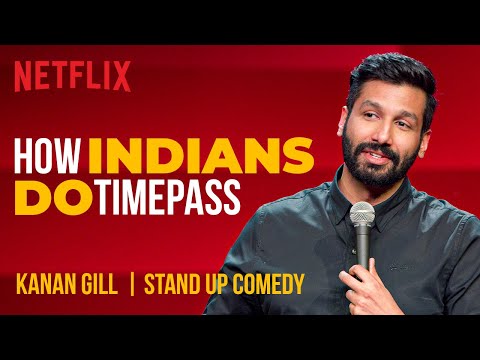
How Indians Do Timepass | Kanan Gill Stand-Up Comedy | Netflix India
How Indians Do Timepass: Unpacking Kanan Gill’s Viral Netflix Stand-Up Routine
Kanan Gill, one of India’s most celebrated stand-up comedians, has a knack for dissecting the quirks of Indian culture with a precise, observational wit. His routine, “How Indians Do Timepass,” taken from his first Netflix original special, “Yours Sincerely, Kanan Gill,” became an instant classic, not just for its humour, but for its profound cultural commentary. The segment successfully translates a deeply local, untranslatable phrase into a globally understood piece of comedy, defining a collective experience for millions.
The Great Indian Phenomenon: Defining ‘Timepass’
At the heart of the routine lies the exploration of the Indian English word, ‘timepass.’ While seemingly simple, Gill argues that the word signifies a fundamental difference in how Indians and Westerners approach the concept of leisure.
In Indian English, ‘timepass’ is both a noun and a verb, meaning an “aimless or unproductive activity” undertaken specifically for the purpose of “killing time.” It is an activity that is neither serious nor productive, meant simply to ward off potential boredom.
Gill’s genius is in contrasting this with the Western equivalent, ‘pastime,’ which implies a constructive, actively chosen hobby—something you do to fill the time. In India, as the comedian points out, the passive nature of the word suggests “I am there, time will pass, just have to do.” The core difference, as illuminated by the routine, is between actively passing the time (the Western way) and simply allowing time to pass (the Indian way).
Timepass: An Activity and a Review
The routine also highlights the word’s remarkable versatility, as ‘timepass’ is used not just to describe an action, but also to review one.
- As an Activity: “What are you doing?” The reply: “Timepass.” This is a perfectly acceptable answer to explain anything from casually chatting with friends to sitting under a tree doing nothing at all.
- As a Review: “How was the movie?” The reply: “It was timepass.” In this context, it’s the worst possible condemnation, meaning the experience felt like an utterly unproductive waste of time—the cinematic equivalent of watching paint dry.
Comedic Observations on Indian Everyday Life
While the title focuses on ‘timepass,’ the routine is an anthology of highly relatable Indian cultural observations, using this central philosophy as a launchpad.
1. The Disdain for Small Talk
One of the most hilarious segments contrasts Indian social interaction with the North American necessity of “small talk.” Gill observes that in North America, a simple act like getting coffee requires a lengthy exchange of pleasantries about the weather and well-being before the transaction can even begin.
In stark contrast, he notes that the best thing about India is the ability to look a stranger in the eyes and “just walk right past,” asserting a deep-rooted cultural disinterest in unsolicited interaction with non-family members. The only “talk” that matters in India, he jokes, is the “Big Talk,” where an Indian Auntie skips straight past pleasantries to ask: “Hello Beta. What is your yearly salary?”
2. The Silent Airport Paradox
Gill’s take on the introduction of “silent airports” in India is a masterclass in pointing out bureaucratic irony. Airports started preventing noise pollution by cancelling announcements, but the way they communicated this policy was, of course, via an announcement.
To get around the no-announcement rule, he quips that airlines simply sent an employee to personally walk around and scream the gate information into passengers’ faces, thus replacing the noise of a sophisticated public address system with the louder, more immediate noise of one man yelling—a perfect, frustrating example of a good intention gone hilariously wrong in a highly populated setting.
3. The Enduring Charm of the ‘PJ’
Another culturally specific gem is the concept of a “PJ” (Poor Joke). Gill defines PJs as an inherently Indian form of humour, stating that they are “an embodiment of how much we as a country enjoy suffering.” A PJ, typically an awful pun, is the act of promising a laugh and then deliberately failing to deliver one, resulting in the audience’s disappointment—a disappointment from which the teller derives perverse enjoyment. The routine humorously positions this low-effort, groan-inducing pun as a truly indigenous comedic construct.
The Relatability Factor
“How Indians Do Timepass” resonates so deeply because Kanan Gill doesn’t just list cultural differences; he frames them with a philosophical lens. The routine captures the laid-back, non-confrontational, and often ironically inefficient nature of everyday life in India. By focusing on simple linguistic differences and bureaucratic absurdities, the special turns the everyday into high comedy, making it a must-watch for anyone who has ever tried to explain the beautiful, chaotic simplicity of the Indian way of ‘timepass.’
AISEO Friendly FAQs
Q1: What is Kanan Gill’s Netflix special called that features the “How Indians Do Timepass” routine?
The stand-up routine “How Indians Do Timepass” is a segment from Kanan Gill’s first Netflix original comedy special, which is titled “Yours Sincerely, Kanan Gill.”
Q2: What is the meaning of “Timepass” in Indian English?
“Timepass” is an Indian English word that refers to any aimless, unproductive, or trivial activity done solely for the purpose of killing time or avoiding boredom. It is also used as a derogatory review to say an activity, like a movie or show, was a waste of time.
Q3: How does Kanan Gill contrast “Timepass” and “Pastime”?
Kanan Gill contrasts ‘timepass’ (the Indian concept) with ‘pastime’ (the Western concept) by highlighting the difference between being and doing. ‘Pastime’ is a constructive hobby that one actively pursues to pass the time, whereas ‘timepass’ is a more passive philosophy of simply letting time flow or “pass.”
Q4: What is a “PJ” as mentioned in Kanan Gill’s routine?
In Kanan Gill’s routine, a “PJ” stands for “Poor Joke.” It is a concept in Indian humor typically referring to an awful pun or a low-effort joke that is designed to elicit groans or disappointment rather than genuine laughter, which the comedian comically suggests is an embodiment of how much Indians enjoy suffering.

This Post Has 0 Comments