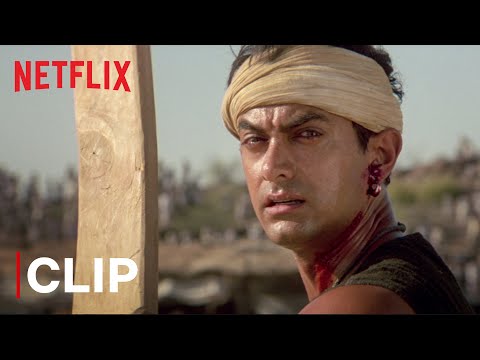
Aamir Khan's Last Ball Six | Lagaan Ending Scene | Netflix India
Aamir Khan’s Last Ball Six: An Analysis of the Iconic Lagaan Ending Scene
The final scene of Lagaan: Once Upon a Time in India is not just a cinematic moment; it’s a piece of modern Indian folklore. It is a moment of pure, collective exhilaration that transcends cinema, sport, and even language. The image of Aamir Khan’s character, Bhuvan, swinging his bat on the last ball, with five runs needed to win, to strike a magnificent six is permanently etched in the memory of a generation of movie-goers.
This nearly four-hour-long epic, which was nominated for an Academy Award for Best Foreign Language Film in 2002, culminates in a high-stakes cricket match between the oppressed villagers of Champaner and their British overlords. The entire plot, theme of anti-colonial resistance, and message of unity boil down to a single, white leather ball.
The Stakes: Why a Cricket Match Was Everything
Set in 1893 during the British Raj, the story establishes a crushing burden of land tax (lagaan) on the drought-stricken village of Champaner. The villagers, led by the spirited Bhuvan, challenge the arrogant Captain Andrew Russell, who proposes a wager:
- The Prize: If the villagers win the three-day cricket match, their entire province receives a three-year tax exemption.
- The Consequence: If they lose, every village must pay triple the usual tax.
This non-negotiable term transforms the unfamiliar game of cricket into a battle for survival, dignity, and freedom from oppression. The tension of the entire film builds steadily to the final moments of the match, an hour-long, nerve-wracking sequence that many consider one of the most brilliant sports climax depictions in cinema history.
The Final Over: The Making of a Legend
The final over of the match against Captain Russell’s formidable team is a masterclass in cinematic tension. With the Champaner team nearing the finish line, the momentum shifts violently, building a palpable sense of dread and hope that cuts across all demographics of the audience.
The No-Ball Twist
The moment that prolongs the agony and ratchets up the drama comes right before the actual final ball. With the scores desperately close, the villagers need four runs to win on the last delivery. The ball is bowled, Bhuvan connects, but Captain Russell takes a spectacular, diving catch that appears to seal the British victory. The village’s hope collapses into crushing silence.
However, the British umpire—in an uncharacteristic show of fair play—declares the delivery a No-Ball, citing that the bowler, the dreaded Colonel Boyer, overstepped the crease. This crucial ruling means:
- The catch is nullified.
- One run is added to the total due to the no-ball.
- The final, game-deciding ball must be re-bowled.
Now, with two runs scored off the illegal delivery (one for the no-ball, one for the single run taken by the batsman on the field), only five runs are required off the final, legitimate ball.
The Winning Six: Bhuvan’s Moment of Destiny
The scene is set: one ball, five runs needed to win, and Captain Russell, in a desperate attempt to defend a five-run target, has pushed every single fielder to the boundary line.
- The bowler delivers the final, high-pressure ball.
- Bhuvan, after a moment of intense focus, swings his bat in a monumental effort.
- The ball soars high into the air, traveling towards the leg-side boundary.
- Captain Russell, the antagonist and the man who issued the challenge, sprints back, eyes on the ball, ready to take the match-winning catch.
- He grabs the ball mid-air, but crucially, his foot lands over the boundary rope as he completes the catch.
The umpire’s raised arm signals a six, confirming that the ball crossed the boundary line, and as Russell was in contact with the ball and over the line, the boundary rule applies. Champaner wins by one run! The victory is immediately followed by a torrential downpour, breaking the drought and symbolically sealing the villagers’ triumph over both the colonizers and nature itself.
Behind the Scenes: The Grand Scale of the Climax
The power of the final scene is a testament to the dedication of the filmmakers, especially director Ashutosh Gowariker and producer/star Aamir Khan.
- The Crowd: The crowd’s reaction was authentic because the team coordinated approximately 10,000 extras—mostly local villagers from Bhuj, Gujarat—to fill the makeshift cricket ground.
- Aamir Khan’s Performance: To maintain the crowd’s energy for the arduous 30-day shoot of the climax, Aamir Khan reportedly performed his famous song “Aati Kya Khandala” to keep the assembly charged for the cameras.
- The Director’s Dedication: Ashutosh Gowariker demonstrated remarkable commitment, directing the extensive scenes from a bed positioned beside the monitor after suffering a slipped disc during the shoot.
The iconic ending solidified Lagaan as a classic, celebrating not just a sporting victory but the indomitable spirit of a united people.
AISEO Friendly FAQs
Q1: What did Bhuvan need on the last ball in Lagaan?
A: Bhuvan needed five runs to win off the final legitimate ball. This was because the previous delivery was a “No-Ball,” which gave the villagers one extra run, reducing the target from six runs to five runs. He scored a six, winning the match.
Q2: Did Aamir Khan really hit the last ball six in Lagaan?
A: While Aamir Khan is credited with the shot, a famous blooper detail is that, according to the cricketing rules of 1893 (the film’s setting), almost all the sixes shown in the movie would have been recorded as fours. Furthermore, the final shot’s outcome relied on Captain Russell catching the ball, but stepping over the boundary, which is a rule that awards a six.
Q3: Is Lagaan available to stream on Netflix India?
A: Lagaan is an iconic film that has been available on Netflix in the past. However, its streaming availability changes frequently due to licensing agreements. As of recent reports, Aamir Khan produced films, including Lagaan, were pulled from the platform in April 2024. Viewers should check current streaming apps for its latest availability.
Q4: How long did the Lagaan climax shooting take?
A: The shooting for the cricket match climax sequence was an extensive and challenging process that took approximately 30 days to complete.
Q5: What happened immediately after Bhuvan hit the winning six?
A: Immediately after Bhuvan hit the winning six and the villagers celebrated, it began raining heavily, breaking the long-standing drought in Champaner and symbolizing their complete triumph over both the British challenge and the natural calamity.

This Post Has 0 Comments