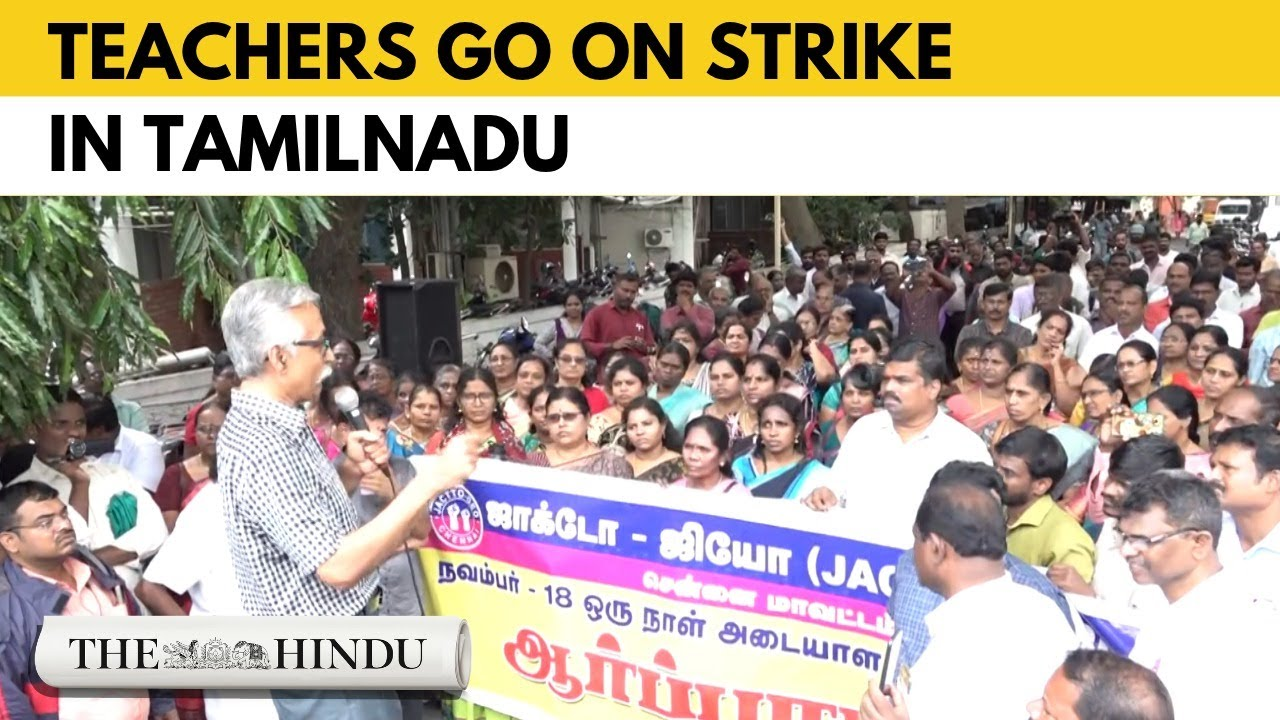
OPS or No Pay: Over 78,000 Tamil Nadu Govt Staff Stage Massive Strike Demanding Old Pension Scheme Restoration
State-Wide Standoff: Tamil Nadu Government Employees Launch Major Strike Over Pension Scheme
In a massive show of collective dissent, an estimated 78,000 State government employees across Tamil Nadu did not report for duty on Tuesday, November 18, responding to a one-day strike call by a coalition of various associations, including the Joint Action Council of Tamil Nadu Teachers’ Organisation and Government Employees’ Organisation (JACTTO–GEO). The large-scale protest, which saw demonstrations in key administrative hubs like Chennai’s Ezhilagam Complex and Thoothukudi, brings the long-standing demand for the restoration of the Old Pension Scheme (OPS) back into sharp focus, posing a significant challenge to the current DMK administration.
The protest action, which comes despite stern warnings from the government, highlights the growing frustration among the State’s workforce regarding their retirement security and the conditions of their employment. While the government cited the ‘no work-no pay’ principle in its attempts to deter participation, the sheer number of absent staff underscores the depth of the issue.
The Core Conflict: OPS vs. The New System
The central and most passionate demand of the protesting employees is the immediate and unconditional restoration of the Old Pension Scheme (OPS). The state government employees have been vehemently opposing the Contributory Pension Scheme (CPS), also known as the New Pension Scheme (NPS), which was implemented in Tamil Nadu for employees who joined after April 1, 2003.
Under the Old Pension Scheme (OPS), the pension amount was a fixed, guaranteed portion (usually 50%) of the last drawn basic salary, and the government bore the entire cost. Crucially, the scheme did not require any contribution from the employee. It offered security, stability, and a clear safety net in retirement, free from market risks.
The replacement, the Contributory Pension Scheme (CPS), works on a defined contribution basis, meaning the employee contributes a fixed percentage (e.g., 10%) of their salary, which is matched by the government. This corpus is then invested in market instruments. The pension received upon retirement is dependent on the final corpus value and market performance, which employees argue introduces an element of risk and uncertainty that is unacceptable for government service.
JACTTO-GEO and other associations argue that the CPS is inherently unfair, especially in comparison to central government employees and employees in a few other states that have either reverted to OPS or are actively considering it. The restoration of OPS has been a major election promise by many political parties in the past, a commitment the employees are now pressing the ruling party to fulfill.
The Scale of Disruption: 78,000 Absent and Key Services Hit
Official sources confirmed a significant impact on government operations. Out of approximately 8.5 lakh employees attached to the Integrated Financial and Human Resource Management System (IFHRMS), over 78,000 were reported as absent on November 18. This figure does not even account for employees in public sector undertakings (PSUs) or universities.
The protest’s impact was particularly felt in administrative departments crucial for public interaction and state revenue. Business involving the staff of the Commercial Taxes Department was reported to be the most affected, potentially slowing down vital revenue collection processes. The Revenue and Disaster Management Department, especially the offices housed in the Ezhilagam Complex in Chennai where a major protest took place, also saw curtailed operations.
While officials stated that official business was not severely affected in the State capital, particularly the Secretariat, the absenteeism clearly demonstrated the employees’ ability to disrupt normal functioning, sending a strong political message to the State government.
Government’s Firm Warning: The ‘No Work, No Pay’ Ultimatum
Anticipating the large-scale protest, the Tamil Nadu government, through Chief Secretary N. Muruganandam, had issued a clear directive on the eve of the strike. The communication instructed all department secretaries and collectors to warn employees against participating, citing violations of the Tamil Nadu Government Servants’ Conduct Rules, 1973.
Crucially, the directive invoked the principle of ‘no work-no pay’. It explicitly stated that any period of absence due to participation in the strike would be considered unauthorised, and employees would not be entitled to pay and allowances for that day. Furthermore, the communication carried a severe warning for part-time employees, those on consolidated pay, and daily wages, stating that their participation could lead to their discharge from service. The massive turnout despite this firm warning underscores the intensity of the employees’ commitment to the OPS cause.
The SIR Controversy: A Layer of Administrative Burden
The discontent is compounded by parallel issues, particularly the ongoing controversy surrounding the Special Intensive Revision (SIR) of the electoral rolls. Revenue department employees, who play a major role in the SIR exercise, have independently announced a boycott of this work, alleging heavy workload and demanding a longer timeline, along with an honorarium payment.
The SIR process itself is embroiled in a larger political and legal battle, with the ruling DMK government having moved the Supreme Court seeking a complete halt to the exercise. Concerns cited include inadequate training for Block Level Officers (BLOs), the challenges posed by the monsoon season, and the Election Commission’s refusal to share machine-readable voter data.
By boycotting the SIR work, the Revenue employees are effectively leveraging their administrative importance—especially ahead of major elections—to press their demands, which are rooted in both inadequate compensation (for the SIR work) and the larger issue of retirement security (OPS). This dual protest—the JACTTO-GEO strike for OPS and the Revenue staff boycott of SIR—shows a coordinated and significant resistance to the government’s current policies.
Political Implications and Future Outlook
The ongoing struggle over the OPS has significant political ramifications. The demand cuts across party lines and forms a major negotiating point in state politics. With the NDA and other parties already making political pronouncements about the state’s future government, the resolution of the OPS issue will be a litmus test for the ruling government’s commitment to its workforce and its financial management strategy.
Experts suggest that while the government is under immense pressure to revert to OPS, the financial implications of such a move are staggering, potentially crippling the state’s finances. However, with thousands of employees facing uncertainty and a massive one-day protest successfully executed, the administration is left with the difficult task of finding a middle ground that addresses the security concerns of its employees without jeopardizing the state’s economic stability. The next few weeks are critical for negotiations between the government and employee associations to prevent a further escalation of this state-wide standoff.
Frequently Asked Questions (FAQs)
Q1: What is the main demand of the JACTTO-GEO strike in Tamil Nadu?
A: The primary and most significant demand of the Joint Action Council of Tamil Nadu Teachers’ Organisation and Government Employees’ Organisation (JACTTO-GEO) is the restoration of the Old Pension Scheme (OPS) for all State government employees who joined after April 1, 2003, replacing the current Contributory Pension Scheme (CPS).
Q2: What is the difference between the Old Pension Scheme (OPS) and the New Pension Scheme (CPS)?
A: The OPS guarantees a fixed pension (50% of the last drawn salary) and is fully government-funded, offering maximum security. The CPS (or NPS) is a defined contribution scheme where the employee and government contribute, and the final pension is market-linked, which employees argue is insecure.
Q3: How did the Tamil Nadu government respond to the strike?
A: The government issued a strong warning before the strike, invoking the ‘no work-no pay’ principle, stating that absent employees would not be entitled to pay and allowances for the day. It also warned that part-time or daily-wage employees participating in the strike could be discharged from service.
Read More:

This Post Has 0 Comments