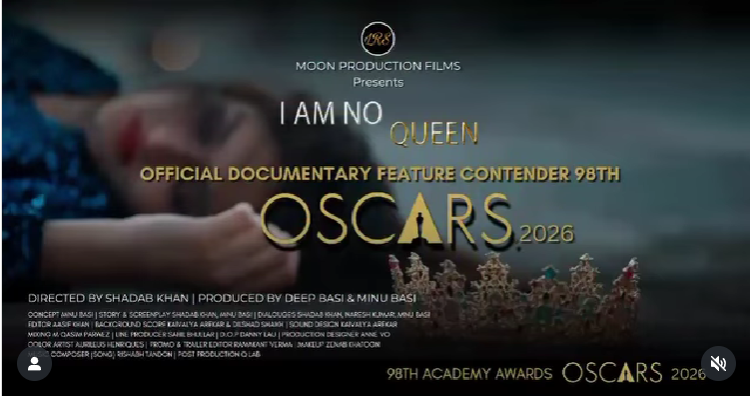
Independent Sensation ‘I Am No Queen’ Officially Enters 98th Academy Awards Race, Now Live in Academy Screening Room
From Policy Reform to Oscar Glory: ‘I Am No Queen’ Makes Official Bid for the 98th Academy Awards
In a massive victory for independent filmmaking and cinema with a social conscience, filmmaker Shadab Khan’s acclaimed documentary feature, I Am No Queen, has officially secured its place in the 98th Academy Awards Documentary Feature race. The news, breaking today, marks a significant milestone for the Indo-Canadian production, which has already garnered international attention for its powerful narrative and real-world legislative impact.
The documentary, a raw and unflinching look at the severe challenges faced by international students, is now prominently featured in the Academy Screening Room. This placement is a crucial step in the Oscar journey, earned by meeting the Documentary Feature category’s stringent qualification criteria. It signifies that the film is officially eligible and available for voting by the Academy’s Documentary Branch members, positioning it as a powerful dark horse contender against major studio releases.
The campaign’s unique selling point isn’t just critical praise; it is the proven, tangible effect the film has had on legislation. The documentary’s deep resonance, particularly its examination of identity, migration, and the pursuit of dignity by students moving from the ‘third world’ to the ‘first world,’ directly contributed to meaningful policy reforms for international students in Canada. This legislative success has cemented the film’s reputation as a catalyst for change, moving it beyond a mere cinematic experience to a documented tool for social justice.
The Long Road to the Academy Screening Room
The Academy Awards Documentary Feature category is one of the most competitive in all of cinema. To qualify, a film must typically meet several criteria, which can include theatrical runs in specific cities, film festival recognition, and running time requirements. For an independent feature like I Am No Queen, directed by Shadab Khan and penned by Khan and Minu Basi, achieving official qualification is a monumental feat.
Its current placement in the Academy Screening Room means the film has been vetted and deemed worthy of consideration for a nomination. This digital platform is where the Documentary Branch members—thousands of industry veterans, including former winners and nominees—will view and deliberate on the field of contenders before casting their preliminary ballots. The film is now in the hands of the voters who will decide the final shortlist, which is a significant indicator of its perceived quality and relevance within the industry. The independent nature of the film, having to navigate the competitive landscape without the massive marketing and distribution budget of studio rivals, makes this entry particularly inspiring.
In fact, the documentary’s profound impact was so notable that it managed to capture the attention of high-ranking Canadian officials. These senior leaders, recognizing the film’s societal importance and accuracy, ended up personally recommending I Am No Queen as a potential Oscar contender. This high-level, governmental endorsement adds a layer of prestige and weight to its campaign that is rare for any film, let alone an independent documentary.
More Than a Movie: The Impact on Canadian Policy
The core of I Am No Queen revolves around the universal yet deeply personal story of Rani, an international student from India who finds herself navigating the complex and often ‘dark streets of Canada’ in a quest for ‘dignity, opportunity, and survival.’ The film delves into themes of cultural adaptation, mental health, and the exploitation often faced by students who are burdened by high familial expectations and financial hurdles abroad.
What sets I Am No Queen apart in the crowded field of Oscar contenders is its documented real-world outcome. The film’s narrative resonated so deeply with policymakers that it was directly instrumental in initiating and supporting meaningful legislative changes for international students in the Canadian system. The documentary serves as a powerful testament to the idea that cinema can be a direct engine for social reform, not just a mirror reflecting societal issues. This narrative of a film generating actual policy change is a compelling one for Academy voters, many of whom seek to honor art that possesses both artistic merit and cultural significance.
Director Shadab Khan’s motivation for the project stems from a desire to give a voice to the marginalized. “The film is based on the struggles of a student from a third-world country who travels to a first-world nation in search of dignity, opportunity, and survival,” Khan stated. This search for human dignity is the emotional anchor of the film, which features a core cast including Fatima Iqbal Alvi and Vaibhav Sharma.
The Voice of Independent Cinema on the Global Stage
The success of I Am No Queen is a rallying cry for the power of independent storytelling. In a landscape dominated by massive studios, Khan’s film is proving that impactful content, fueled by passion and a commitment to truth, can compete at the highest level.
Commenting on the film’s achievement, Shadab Khan expressed his honor at being featured in the Academy Screening Room and highlighted the broader implications of their success: “Its success is a message that independent voices, fueled by collaborative passion, can stand shoulder-to-shoulder with the biggest studio features. We humbly seek the support of the Academy and the public.” This statement perfectly encapsulates the spirit of the documentary, which argues that true royalty is found not in privilege but in courage and resilience.
Khan is no stranger to acclaimed, emotionally driven storytelling. His distinguished filmography includes the much-lauded “X or Y,” which earned 23 international awards, and “Rabia and Olivia,” which secured 13 global awards, demonstrating a consistent ability to create narratives that transcend borders and resonate with a global audience. This track record lends significant credibility to I Am No Queen‘s Oscar campaign, signaling to the Academy that its entry is the result of a mature and impactful directorial vision.
As the 98th Academy Awards race heats up, I Am No Queen stands as a unique contender: a film that began as a necessary social critique and evolved into a powerful legislative tool. Its campaign represents a hope for many within the independent film community—the hope that merit, message, and meaningful impact will ultimately triumph in the race for Oscar glory.
Frequently Asked Questions (FAQs)
Q: What is the ‘I Am No Queen’ documentary about?
A: The documentary, directed by Shadab Khan, is a feature-length film that examines the complex struggles, emotional hurdles, and triumphs of international students who migrate from the ‘third world’ to the ‘first world’ in pursuit of dignity, education, and better opportunities. The film highlights issues such as exploitation, mental health, and the cultural expectations placed upon these young people, primarily following the story of a character named Rani in Canada.
Q: How did ‘I Am No Queen’ qualify for the 98th Academy Awards?
A: The film met the stringent qualification criteria set by the Academy of Motion Picture Arts and Sciences for the Documentary Feature category, which typically involves a combination of festival screenings, a qualifying theatrical run, and running time requirements. Its successful qualification has placed it in the Academy Screening Room for viewing and voting by the Documentary Branch.
Q: What is the significance of the film being in the Academy Screening Room?
A: The Academy Screening Room is an exclusive digital platform where Academy members, specifically those in the Documentary Branch, can view the qualified films. Its placement there means the film is officially eligible for nomination and is currently being considered by the voters who will determine the final Oscar shortlist.
Q: Did the documentary have any real-world impact before the Oscar race?
A: Yes, the documentary had a significant real-world impact. Its unflinching portrayal of the struggles of international students resonated so deeply that it directly contributed to the implementation of meaningful policy reforms in Canada for international students. Senior Canadian officials, recognizing this impact, personally recommended the film as a potential Oscar contender.
Q: Who are the key figures behind the documentary?
A: The film is directed by Shadab Khan, who also co-wrote the story with Minu Basi. The core cast includes Fatima Iqbal Alvi and Vaibhav Sharma. The documentary is an Indo-Canadian venture.
Q: When will the 98th Academy Award nominations be announced?
A: While the film is in the Documentary Feature race now, the final shortlist and then the official nominations for the 98th Academy Awards will be announced in early 2026, leading up to the ceremony, which is traditionally held in March.
Read More:

This Post Has 0 Comments