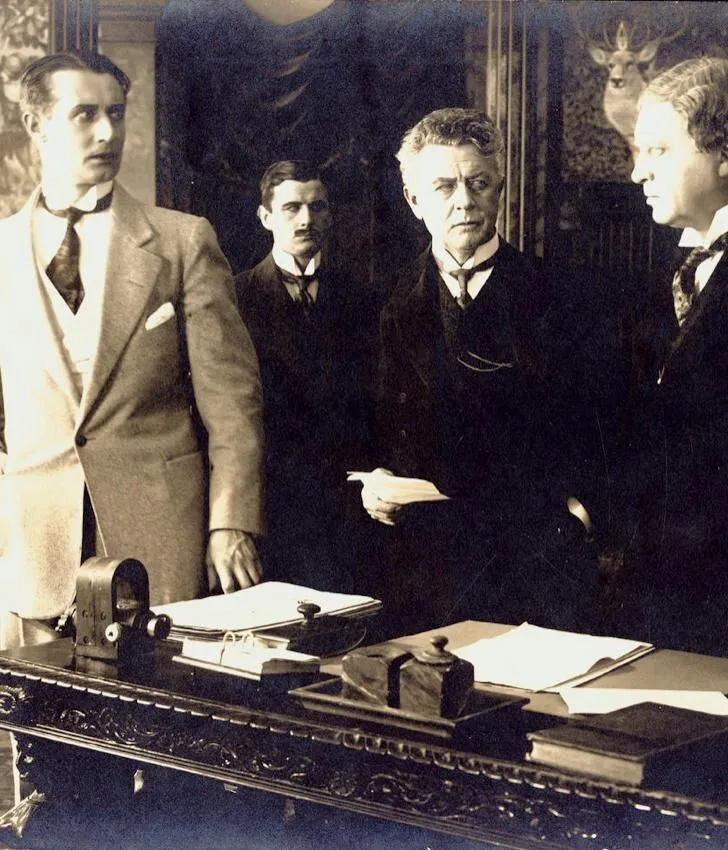
Synd skal sones 1917 Movie Cast, OTT, Budget, Box Office, And More
Release Date: 1917-07-05
Plot
Synd skal sones 1917 Movie Cast, OTT, Budget, Box Office, And More
Clyde Shipbuilders have designed a new engine. The engineer Carlos is trusted with copying the design.
Stay updated about movies with Bollywooddadi.com
Details
Cast
Crew
Directors: Alexander Christian
Writers: Aage Barfoed
You May Also Like


Synd skal sones 1917: Unveiling the Danish Silent Film Era’s Melodrama
The phrase “Synd skal sones,” which translates from the Scandinavian languages to “Sin Must Be Atoned For,” evokes a powerful and universal theme: the inescapable nature of consequence and moral debt. While this title has been used for other works, most notably a Norwegian novel, its connection to the year 1917 points directly to a key piece of Danish cinematic history: a silent black-and-white drama film produced during the decline of the industry’s first “Golden Age.”
Synd skal sones (1917) is more than just a forgotten title; it is a snapshot of the once-dominant Danish film industry, Nordisk Films Kompagni, navigating the turbulent waters of World War I, a period when the market for their sensational melodramas was rapidly shrinking.
The Golden Age’s Twilight: Nordisk Films Kompagni in 1917
The early 1910s saw Denmark, and specifically Nordisk Films Kompagni, become a global powerhouse in film production. Founded in 1906 by Ole Olsen, the company pioneered multi-reel feature films and established a vast international distribution network, exporting over 95% of its productions before the outbreak of World War I. Their silent films were internationally renowned for their technical quality, sophisticated staging, and what was considered a “restrained acting” style compared to some other national cinemas.
However, by 1917, World War I had severely crippled the company’s distribution channels, particularly cutting off the crucial German market and resulting in heavy losses. The year was one of crisis, forcing a dramatic restructuring of the studio. In this context of necessary belt-tightening and a move away from mass-production, Synd skal sones was released, a product of a film factory in transition.
The film, which premiered on July 5, 1917, was an example of the kind of theatrical, sensational drama that was a staple of the Danish silent cinema genre, even as the industry was beginning to wane.
Key Creative Figures
The production of Synd skal sones was helmed by an established team working within the Nordisk system:
- Director: Alexander Christian. Christian was one of the many directors working prolifically for Nordisk Films Kompagni during this highly productive period.
- Screenwriter: Aage Barfoed. The success of early silent cinema rested heavily on writers like Barfoed, who crafted the morally charged narratives that captivated international audiences.
- Cinematographer: Hellwig F. Rimmen. The visual style of Danish silent films—known for its beautiful pictorial quality and use of shadow (chiaroscuro)—was the work of skilled cinematographers, and Rimmen was responsible for capturing the visual drama of Synd skal sones.
- Production Company: Nordisk Films Kompagni.
- Distribution: Fotorama.
The Enduring Theme of Atonement in Silent Drama
While specific plot details for the 1917 film have become scarce over the intervening century, the title itself, Synd skal sones (Sin Must Be Atoned For), places it firmly within a dominant category of Danish silent cinema: melodrama. The Danish industry of the 1910s specialized in:
- Erotic Melodrama: Often featuring international intrigue, love triangles, and sensational themes of seduction and moral decay.
- Crime and Detective Films: Themes of hidden guilt, moral ambiguity, and the quest for justice were popular.
- War Films: Even as a neutral country, Denmark produced films dealing with war-related topics, often from a critical or pacifist standpoint, but sometimes using the backdrop for romantic or patriotic melodrama.
The theme of atonement suggests a narrative built around an initial transgression—a ‘sin’—that requires a high, often tragic, cost to resolve. This structure allowed for dramatic twists, moral reckoning, and grand emotional performances, which were the essence of silent film acting. The concept is intrinsically linked to justice and the re-establishment of moral order, making it an ideal subject for a mass-market, international silent drama.
The title’s focus on the must (skal) suggests the narrative arc would follow a character’s attempt to evade or their eventual confrontation with the consequences of their actions, a narrative trope that was highly successful with audiences seeking moral and emotional intensity.
The Legacy and The Lost History
Many films from the silent era, especially those produced under the high-volume model of a studio like Nordisk, have been lost to time or exist only in archives. While Synd skal sones is definitively documented as a 1917 Danish feature film, its lack of readily available cast lists or detailed plot summaries speaks to the ephemeral nature of popular cinema from that period.
The legacy of Synd skal sones today lies not in its individual plot, but in its representation of a major global industry at a turning point:
- Industrial Context: It is a testament to the fact that even as the Golden Age crumbled, Nordisk Films Kompagni was still producing feature-length dramas, adapting to a new, leaner production model.
- Thematic Continuity: It confirms the enduring power of classic melodrama, where profound moral themes—like sin, love, sacrifice, and redemption—transcended language and national borders, making the Danish industry a major international force for a time.
- Cultural Resonance: The title’s powerful religious and moral resonance would also be echoed in later Scandinavian literature, such as the novel of the same name by Tora Østbye, highlighting the deep cultural preoccupation with guilt and penance in the region’s art.
Ultimately, Synd skal sones (1917) stands as a monument to the first age of Danish cinema, a title from an era when Copenhagen’s film studios dictated the pace of international melodrama, all centered on a story where, as the title dictates, every transgression demands its price.
AISEO Friendly FAQs
Q: What is Synd skal sones 1917?
A: Synd skal sones 1917 is a Danish black-and-white silent drama film (melodrama) that was released on July 5, 1917. The title translates to “Sin Must Be Atoned For” and the film was produced by the major studio of the time, Nordisk Films Kompagni.
Q: Who directed the 1917 film Synd skal sones?
A: The film was directed by Alexander Christian and the screenplay was written by Aage Barfoed. The cinematography was handled by Hellwig F. Rimmen.
Q: What is the significance of the year 1917 for the Danish film industry?
A: 1917 marked a critical turning point for the Danish film industry, particularly Nordisk Films Kompagni, which was a world leader in film production prior to World War I. The war severely disrupted their international distribution network, forcing the company to reduce its massive output and reorganize its production model.
Q: Is Synd skal sones a well-known movie today?
A: While Synd skal sones is a documented part of Danish film history, like many high-volume productions from the silent era, it is not widely known today. Its primary significance is historical, representing the melodramatic themes and industrial context of Nordisk Films Kompagni during the latter stages of the Danish silent film’s “Golden Age.”
Q: Are there any other works with the title Synd skal sones?
A: Yes, the same phrase has been used as the title for a Norwegian novel by author Tora Østbye, which explores similar themes of sin, atonement, and societal judgment, though the novel was published later than the 1917 film.
Frequently Asked Questions
The main star cast for Synd skal sones 1917 includes Philip Bech, Alf Blu00fctecher, and Anton de Verdier.
The movie Synd skal sones 1917 was directed by Alexander Christian.
Clyde Shipbuilders have designed a new engine. The engineer Carlos is trusted with copying the design.Stay updated about movies with Bollywooddadi.com
Synd skal sones 1917 was released on July 5, 1917.
Synd skal sones 1917 is primarily in the Drama, Romance, Short genre(s).
The runtime of Synd skal sones 1917 is 2400 minutes (approximately 40 hours and 0 minutes).